Welcome

Welcome to Andres' Blog

domingo, 5 de septiembre de 2010

East Asia


Japan and South Korea


First to understand the comparison between these culture, it is important to understand the paradox of Convergence vs Divergence. Convergence means that as countries as they internationalize, they will follow a models found in developed countries, which will make at the end that management styles tend to be very similar in many aspects. Divergence says that the cultural values of each society are strong enough to create resistance to foreign influence in they management styles.

Japanese and korean management styles can be seen as very similar but at same time as different styles. The convergence between Japanese and Korean managements is because Korea saw in the early 50’s how Japan was vigorous recovering of its defeat at World Word II and saw in Japan the model to its own national effort to success. But the willingness to incorporate the Japanese system by itself its not enough reason to guarantee that its implementation will be successful, what do really help to bring those managements styles to converge can be explain in the long history that Korea and Japan had shared (Buddhism, Taoism, Confucianism) and the Japanese occupation of Korea from 1910 until 1945 years, which are the reasons while they share some core values, that allow the koreans to successfully integrate many aspects of the Japanese management into their own style.

Japanese and Korean big corporation are organized in groups of companies that own each other stocks and participate in different sectors of the economy. In Japan such groups are known as Keiretsu (before World Word II known as Zaibatsu) whereas in Korea are known as Chaebols. Their structure is very similar and apply the same concept of conglomerate. The main differences between both are in first place that Keiretsus are organized around a central bank that finance them, whereas Chaebols resort to government for financial support, another difference is that Keiretsus nowadays are controlled by a group of professional, Chaebols still being controlled by founding families. Finally keiretsus have no longer strong ties to the government and Chaebols family owners have strong ties with the government.

Embedded in the Japanese and Korean culture is the concept of groupism, inside and outside the company, by which many of the management and organizational characteristics of the Japanese and Koreans will be dependent. But this doesn’t mean that Japanese work the same. For Japanese the most important is the group cohesion and harmony, but for Koreans hierarchy respect within a group is what matters.

The decisions Making in Japan is done in a bottom-up system. This means that at the lower or middle sections of the organization proposals are generated by work groups and then given to all relevant sections of the same level and then to higher levels to section heads, managers, directors until it finally reach the company president. In contrast in Korea the process is top-down, which means that in Korean organization Top management takes the decisions and then send them down thorough a chain command until the lower levels of the organization

Life Employment it is common practice carry out by big corporations in Japan and Korea, although in Korea this practice is done in a more flexible way an in a lees amount of employees. Japanese and Korean corporations have a hierarchical structure based on age and length of service but in Korea there is also the use of the merit system by which individual al measured.

All those differences make that the Japanese and Korean managements styles converge in at grate extent but at the same time have their own peculiarities.


1. List the main similarities and differences of Japanese and Korean management styles.

I’am going to focus in the dimensions of management style defined in the model of (Jangho Lee, Thomas W. Roehl and Soonkyoo Choe) and its conclusion.


Dimension

Japan

South Korea

Strategic Goals

Market share and profit maximization

Market share an profit maximization at a greater extent than the Japanese

Environment Analysis

Active at monitoring both they rivals and the suppliers of substitute goods.

Active at monitoring they rivals.

Technology development and manufacturing

Long-term technology development and Economies of scale in manufacturing making emphasis on flexible manufacturing systems.

Long-term technology development and Economies of scale in manufacturing.

Supplier Relationship

Cooperation with their suppliers and development of long-term relation with them.

Cooperation with their suppliers and development of long-term relation with them.

Closeness with customers

High emphasis on the importance of information exchange with costumers.

Less emphasis on the importance of information exchange with costumers than the Japanese, but as enterprises internationalize the gap becomes smaller.

Marketing

Importance in the development of corporate/trademark.

Importance in the development of corporate/trademark in internationalized enterprises.

Human resource management

Employees and their suggestions are very important in management.

Employees and their suggestions are less important in management that in Japan.

International Orientation

Conduction of customer analysis on a global basis and highly involvement on international marketing.

Conduction of customer analysis on a global basis and highly involvement on international marketing.


2.In the case of Korean and Japanese management styles, do you think they tend to converge or diverge? Are they likely to converge to each other or to other management styles (Western, Asian, etc).

In my opinion Korean and Japanese management styles tend to converge as we see that many aspects of the Korean management styles are adopted from the Japanese management styles. Also this two cultures share some history specially religion and philosophy that allow them to share at a certain extent values, attitudes and beliefs, which make for Korean organizations and easy task to implement the Japanese model without much resistance so they convergence is granted. As management styles adoption depends on its success, so as long a the Japanese model remain successful natural convergence will go to it, but as mention not all dimensions of a model are successful so Korea and even Japan will look at another Management styles as they are doing now after the Asian crisis of the mid 90‘s, and the model they have looked has been the American model, prove of this slightly shift to the american model are the new regulations implemented in Japanese organization in terms of performance over seniority for positions within a company and salaries. They will then tend to look for a new management style that resolve their model drawbacks and improve their actual model.


Sources:
  • El Kahal, Sonia, Business in the Asia Pacific, Oxford University, 2001, p146, 20p, Japanese Management.(EBSCO database)

  • Leanne Fiftal Alarid, Hsiao-Ming Wang, (1997) "Japanese management and policing in the context of Japanese culture", Policing: An International Journal of Police Strategies & Management, Vol. 20 Iss: 4, pp.600 - 608. (Emerald database)

  • Lee Jangho, Thomas W.Roehl & Sookyoo Choe, 2000. What Makes Management Styles Similar and Distinct Across Borders? Groeth, Expirence and Culture in Korea and Japanese Firms. Journal of International Business Studies, 31 (4): 631-52

  • Asia Pacific Journal of Management; Jun2009, Vol. 26 Issue 2, p333-351, 19p, Japanese keiretsu: Past, present, future.(EBSCO database)


sábado, 4 de septiembre de 2010

Organizational Communication + Virtual teams


Organizational Communication


First start by giving a definition of comunication: “Communication is the evoking of shared or common meaning in another person”(1). In spite of the fact that there are to types of communication interpersonal communication and technological communication (email, teleconferencing, e-meetings), i’m only focusing on interpersonal communication.


Interpersonal communication is the one carry out by two or more people in an organization through direct contact “Face to Face” by which people built and sustain relationships at work. This kind of communication has four key elements: sender, receiver, perception filter and the message.


Image 1

Inside organization effective communication is very important in order to maintain coordination and transmit the correct information between all members of a organization. That is why reflective listening is a very important aspect inside a any organization as it allows receiver and sender to better and clearly understand any given message. Reflective listening consist of four levels of verbal response: affirming contact, paraphrasing expressed thoughts and feelings, clarifying implicit thoughts and feelings, and finally reflecting core feeling not fully expressed(2). This kind of communication requires the involvement of both sender and receiver in order to be successful in avoiding misunderstandings and generate a clear message.


When talking about communication we can no forget that most of the communication process takes the form of nonverbal communication, so it is important to be able to control this kind of communication in order to positively influence the communication process. This appear more important when dealing with people of other cultures as many of their nonverbal communication is very different from ours.The aspects to be taken into account are: proxemics ( the perception of space), kinesis ( body movements), Facial and eye behavior, and paralanguage (Variations in speech).


There is also important to take into account the barriers for communication as if we know them we can avoid or correctly manage them. The most common important are: language, semantics, noise, time, distance, age, gender, status, attitudes and values, perception, close-mindness, distortion, bad listening and emotions.


Virtual teams


Virtual teams can be defined as “a group of geographically and/or organizationally dispersed coworkers assembled using a combination of information and communications technologies for accomplishing and organizational task”(3).


The advantages of virtual teams can be:


Reduction of costs

More time flexibility for employees

Productivity increase

Taking advantage of talent work force spread around the world

Sharing of information around the world


The disadvantages of virtual teams can be:


The cost of setting virtual networks

Control is difficult

Ineffective communication (Lack of face to face communication)

Not all people have the psychological disposition to be part of a virtual team.

Training of personal.

Different time zones, cultures and languages

Lack of trust


In conclusion virtual teams will not replace traditional teams because not all organizational structures allowed their implementation but for those that allow virtual teams, specially knowledge organizations or knowledge areas within an organization, appear as a great opportunity to improve development of many organizational projects.


Based on the article “If Intercontinental were a sound…what would it be?”*, Please discuss the implications (potential advantages, disadvantages, challenges, etc.) of using sounds to send strategic messages. You need to integrate the use of key concepts relating to the topic of communication to support your answer.


When we talk about communication the first thing that comes to our mind are words but as it has been proved that around 65 to 90 percent of the meaning carried by a message is done through nonverbal communication. Thus, sounds appear as an important aspect to sent strategic messages with satisfactory information to costumer because sounds if well chosen, they can go deep into the peoples values’ core and create a positive attitude and perception of given brand by making it acknowledgeable and appealing to consumers.


The problem of using sounds is that at first glance they are a very subjective concept and what can be appealing to someone can not be to other. So in order to identify which sounds are appealing to a wide group of people the perception screens have to be over come in order to go deeper into the core values that identify any given group in order to avoid giving the wrong message.

sources:
  • (1) Nelson, D.L & Quick, J.C. 2010. Organizational Behavior: Science, The Real World and You. South-Western College Publishing. Chapter 8.
  • Image 1: http://www.infofanz.com/2009/01/29/the-business-communication-1 (2010)
  • (2)Nelson, D.L & Quick, J.C. 2010. Organizational Behavior: Science, The Real World and You. South-Western College Publishing. Chapter 8.
  • (3) A. M. Townsend, S. DeMarie, and A.R. Hendrickson, “Virtual Teams: Technology and the work- place of the future,” Academy of Management Executive, 12, 3 (1998), pp. 17–28.


domingo, 22 de agosto de 2010

Motivation


Motivation means “the psychological feature that arouses an organism to action toward a desired goal; the reason for the action; that which gives purpose and direction to behavior”(1)


In other to explain, predict and influence human behavior, some motivation theories, based on internal needs and external incentives, have been developed. The most known theories are:


Maslow’s Needs Hierarchy says that there are some needs that are basic to all human beings, and in their absence nothing else matters. As we satisfy these basic needs, we start looking to satisfy higher order needs and once a lower level need is satisfied, it no longer serves as a motivator.

Image 1


Theory X and Theory Y Theory was developed by Douglas McGregor. People is classified as either X or Y. X type is lazy, dislike working and responsibilities, don’t have ambitions, whereas Y type sees working as something valuable, is involve in the organization, is creative and enjoy responsibilities. Further more Douglas includes the Maslow hierarchy as a way to motivate both types; lower order needs for type X and higher order needs for type Y.


ERG Theory was developed by Clayton Alderferer. This theory simplifies Maslow’s Hierarchy of needs in three groups, what is now its the concept of regresion that means that when people fail to achieve a higher level, they will come back to a lower level and intensify they satisfaction in that level


Image 2

McClelland’s Needs Theory says that an individual has a combination of needs ( Achievement, Power or Affiliation), and that what can motivate an individual can be found by identifying the dominant need of a individual.


Herzberg’s Two-Factor Theory identify two types of factor:


Image 3

Hygiene factors if no well provide, they are a source of dissatisfaction; but if well provide they not really generates motivation as they are commonly given by granted by employees. Motivator factor are the one that matter in other to motivate employs to go further.


There are also other theories based on processes and the more important ones are:


Work Motivation and Equity Theory refers to the action of comparison of an individual’s outcomes and inputs against someone else, and the result of feeling under pay or over pay as a motivational factor.


Image 4


Expectancy Theory says that an individual gets motivated after assessing if his effort will lead to a positive performance that at same time provide him with a positive and desirable reward.


Image 5


1. What are the Hawthorne Studies? explain its importance for studying motivation at the workplace and its influence over diverse motivation theories.


As The Hawthorn Studies are known those studies conducted to a group of female workers at the Western Electric by its managers and a group of researches from Harvard University between 1924 and 1932. The objective of this investigation was to prove Taylor’s idea that more light in the workplace would increase the productivity of workers. But what researchers and managers did discover was that despite a reduction in light provided to work areas, Productivity would still rise. After this findings the investigation focused on the relation ship between managers and workers However, to the amazement of the researchers, the experiment showed productivity rising still further, even with a decrease in illumination. The investigation then turned its attention to the relationship between managers and workers, and its relation in improving workers productivity while changing the environmental conditions. “After conducting a number of experiments, they finally concluded that the improvements in productivity happened almost solely due to social factors, such as moral and satisfactory inter-relationships within the production team. The study also showed that just the fact of being chosen for the study motivated workers to continually improve production, regardless of the working environment (Mayo, 1949; Wren, 1994; Weihrich and Koontz, 1993; Lee and Schniederjans, 1994)”. This phenomenon was then coined as The Hawthorn Effect.


Even thought these studies started with a different purpose and objectives, it became such important approach to understand motivation inside the organization, when there was no real studies on performance based social behavior, and when the most important aspect to understand motivation was based on external physical incentives.Although, these studies have received recently a lot of criticism by many scholars because of the method, which created what is known as Hawthorn Effect, and the inconclusive data that, two facts that ended up corrupting the studies’ conclusion on the importance of social relation on motivation, there is a very important legacy from them to the organizational understanding of motivation. This legacy refers to the realization of investigators that motivation was not only a matter of external incentives but that it was very important to focused efforts to understand the behavior of the individual in terms of internal needs and the group dynamics that organizations promoted.That is way after this studies we started seeing theories such as Maslow’s Hierarchy of Need and all its variations, Herzberg’s two-factor theory, Equity and Motivation Theory and the Expectancy Theory. I would say that dispite the fact that Hawthorn studies might not be a reliable source of understanding motivation at work, they really gave the bases to the new organizational researchers to go further in developing more integral theories base on the individual.


2. Based on the class activity about "Flight 001: Motivating Employees", please answer the following question:

¿Which motivation theory do you think has the most relevance for understanding the behavior of Griffin and fostering her motivation at work?

In my opinion the theory that has most relevance for understanding the behavior of Griffin and fostering her motivation at work is Herzberg’s Two-Factor Theory. This is because first it explains the importance of provide hygiene factor to a person in order to avoid dissatisfaction and Motivators to improve their Job satisfaction and motivation. What happened to Griffin at her old Job was that she did not have a Job security and its manager and job did not also provide her with any of Herzberg’s motivator so she quit her job, but the story was completely different for her at Flight 001. She found there that hygiene factors were provided so she did not become dissatisfy but also that hygiene factor such as achievement, recognition,responsibility and growth make her motivated at many different aspects that she literally fell in love with his job an feel herself satisfy and ready to give her best at working in Flight 001.


Sources:


sábado, 21 de agosto de 2010

Personality, Perception and Attribution + Attitudes and Values

When talking about personality, perception, attribution, attitudes and values, where are referring to variables that influence individual behavior and group dynamics. Because of this, it is very important to understand each of this variables.


Personality can be define as relatively stable set of characteristics that influences an individual’s behavior(1) that is determined by heredity and the environment. There are many theories in order to understand this variable.


First there is the Trait Theory by Gordon Allport, this theory try to understand individual by identifying observable and stable traits in the behavior of a certain individual for example the Big Five Personality Traits.


Second we have the Psychodynamic Theory, which focused on the unconscious determinants of behavior.

Image 2

Third there is the , emphasized individual growth and improvement.


Image 3


Lastly there is a Integrative Approach, which describes personality as a composite of individual characteristics and situational variables.


Inside the organization, it is possible to identify some personality characteristics. The first one is Locus of Control that can be internal ( i control what happen to me) and external (people and circumstances control what happen to me). The second one is Self-Esteem that refers to how worth someone feels of itself so it can be either positive or negative. Third one is Self-Efficacy which means what a individual believes in terms of accomplishing a specific task. The forth one is Self-Monitoring this refers to behavior based on cues from people and situations. The fifth one and final its Positive/Negative Effect, which refers to the acceptances of positive aspects or the accentuation of negative aspects.


Perception is about how people interpret information about another person based on perceiver, target and situational characteristics, but this is not done without some barrier such as Selective perception, Stereotyping, First-impression error, Implicit personality theory, Self-fulfilling prophecies


Attribution explains how individuals explain the causes of the behavior of themselves or others, these causes can be internal (person) or external (Situation).


Attitudes refers to feelings, negatives or positives, about aspects of our environment. Attitudes also reflect the way a person will behave but there might be incongruence between both and it is known as cognitive dissonance. At the work place, there are two particular attitudes that have the greatest potential to influence how people behave. These are job satisfaction and organizational commitment.


Values refer to stable beliefs that people have an consider important to them according to a cultural background, what is important to me might no be for someone else. For example achievement, concern for others, honesty, fairness and so on.


1. Please explain, using your own words, the concept of Pygmalion Effect.


What are the potential implications, uses, or challenges that this effect may pose for organizations engaging into international operations that require the understanding of diverse cultural contexts? Can you use this concept to explain the relationship between national and organizational cultures?


The Pygmalion Effect is a way to understand how our expectations about someone else can affect the way they will perform when we interact with them, as we unconsciously will display a special treatment base on our expectations toward those people, and they at the same time will internalize those expectations and transform them in a accordingly behavior. So for example if a sells manager expects its subordinates to reach the organizational goals, this manager treat his subordinates in a positive way, then they will internalize this positive feeling and will externalize in a way that they will perform better in order to achieve the goal, whereas if the expectations are negative then the result will be negative as well.


The Pygmalion effect appears a every important phenomenon to be understand by any organization, but especially those corporations that are engaged in international operations as they are the ones with most conflicts when trying to set up and operation in a different country because many times they do not realized of the danger of not understanding the cultural context of the people they are employing abroad. The problems appear when people from one country goes to another country with out really understanding the national culture of the host country, because this lack of knowledge crates stereotypes. The danger of stereotypes is that most of them tend to be in a negative context and most of the time stereotypes do not even group the majority of the people of a nation, and what occurs is that people creates bad expectation of others because of them. So by understanding this problem from the point of the Pygmalion effect, organizations will become conscious that negative expectations will create conflicts and lose of performance, and will realize the importance of understanding the culture of the host country in order to train managers able to understands others people culture, and in this way managers will create good expectations of the people they have in charged, which will be traduce in better performance of the employees. It important to say that cross-cultural training is neither easy nor for everyone, because people might find many of other people values incompatible with each own values, so people fit for this kind of training has to be carefully chosen in order to select openminded and caring individual.


I would say that this concept does not explain the relation of national culture and organizational culture, because the Pygmalion effect refers to a concept for understanding behavior of an individual and does not show any linkage to explain any relationship between national and organizational culture concepts, but what it does is that it makes us realize the importance of understanding both types of cultures in order to avoid value conflicts that creates negative expectations over a group and that finally leads to conflict, stress and demotivation of people, whereas healthy and positive environments produced significantly important improvements of performance of people within an organization.


Sources:

  • (1) Nelson, Debra L. and Quick, James Campbell. 2010. Organisational Behavior – Science, the Real World, and You. South-Western Cengage Learning, Mason, USA. Chapter 1 and 2. Pp. 78
  • Image 1, Talya Bauer, Berrin Erdoga, Organizational Behavior, Chapter 3
  • Image 2, http://articles.directorym.net/Psychodynamic_Perspectives_Richmond_VA-r1047481-Richmond_VA.html
  • Image 3, http://webspace.ship.edu/cgboer/rogers.html
  • Takao Inamori, Farhad Analoui, Beyond Pygmalion Effect: The role of managerial perception, Journal of Management Development, vol. 29 Iss: 4, pp. 306-32

Organizational Behavior, National and Organizational Culture


When we talk about Organizational Behavior, we refer to de study of individual behavior and group dynamics inside organizations through the use of many disciplines that complement each other such as Psychology, Sociology, Engineering, Anthropology, Management and Medicine.


Human behavior is such complex and broad subject at this stage its important to grouped it into two major perspectives. The first one is the internal perspective, which says that people behaves according to feelings, thoughts, past experiences and individual needs. The second one is external perspective that considers that human behavior depends on factors outside the person such as external events, and environmental forces.


When it comes to the organizational context , we can identify first the organization as an open system where internal components (people, technology, tasks and structure interact to each other, and with the environment trough inputs (Material, Capital, Human),corporation’s task environment (Competitors, Unions, Regulatory agencies, Clients) and outputs (Products, Services). After this, we can identify in side the organization two forms of design. One form can be compered with the smooth and organize functioning of a clockwork so here we can find goals an objectives,policies and procedures, authority structure and all those thinks that make a corporation integrate an follow a same path of behavior. The other form, the informal organization can be compared with the unpredictable and confusing snake pit and in this type of organization we find beliefs and assumption, perceptions and attitudes, feelings, informal leaders and all those components that deflect the formal organization from its course.


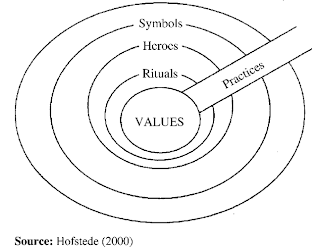
But non of these make sense if the role of culture and its influence are not taking into account when studying an organization and the individual, because culture has impacts in all the dimensions to be study in an organization such as managements processes, costs, negotiation, communication, production, advertising, employees relations and so on. By culture it is meant : “the collective programming of the human mind that distinguishes the members of one human group from those of another. Culture in this sense is a system of collectively held values” (Geert Hofstede). In these sense we refer to what its important when studying an organization those share values that induce certain behaviors in a group of people. It is important to remember that although there is the conception of national culture it can be misleading as even within one nation, we can find many subcultures that differ from the so called national culture. The important thing here is to recognize the importance that culture has in shaping a organization.


To understand national culture there are some theories such as Cultural Clusters by Gupta, Trompenaar’s cultural dimensions, Hofstede’s cultural dimensions. This theories facilitate the understanding and comparison between cultures. After we understand National culture can we then understand the culture inside a organization as set of values, beliefs, and assumptions considered appropriate in thinking and acting inside an organization by all its members. Organizational culture have two functions, one internal, which refers to how members relate to each other, and one external, which refers to how a organization adapt to the environment. We can then identify that there are advantages and disadvantages of having a strong organizational culture, for example for strong culture its easy to draw consensus, core values are intensely held and widely shared, reduce potential conflicts and so on, but it also carry inflexible cultural barriers, resistance to chance and biding people together in a defensive way. So by understanding this we can asses the two paradoxes ( Consistency vs Adaptability, and Top-down vision vs Bottom-up involvement)


1. Considering the conference "Dealing with Cultural Differences" by Nick B. Meyer, choose cultural dimension and use 2 hypothetical but realistic situations - or real ones - to illustrate the business implications of cultural differences. you may not use situations or examples already discussed in class or in the conference.


High Individualism


A. For example in a American organization if sells star to decrease, the sells management is the one responsible for this and for a solution, and in the case of failure he/she is the one to be punished. Whereas in a Japanese organization if the happens, the section of sell, which is composed by one o more working groups, its the one responsible and the solution is expected to be designed by all members of the section while sharing ideas and proposals between them, so in the case of failure the group is the one to be punished.


B. For example Korean people when speaking they doesn’t use the possessive word my except for some specific situations as for them my means greed and selfishness so instead the use ours. Wheres individualistic societies refers always to my


2. Write a short essay considering the following questions

- Do you think there is a corporate culture in every organization?

- If we assume there is: Can it be modified?


According to Helen Deresky “The culture of a society comprises the shared values, understandings, and goals that are learned from earlier generations, imposed by present members of a society, and passed on to succeeding generations. This shared outlook results, in large part, in common attitudes, codes of conduct and expectations that subconsciously guide and control certain norms of behavior”. By taking this definition from the national concept to the organization we find that this statement explains as well what happens in a more small scale. In this sense a would affirm that every organization has it own culture, even within the same national culture because every time people band together, the interaction and bonds that those people creates make for new behavioral patterns that end up developing a new and unique group culture that represents that group and which affects employees and organizational operations, making every organizations develops its own corporate culture. Its important to bear in mind that culture developed in each organization can be either a cohesive or destructing force.


This affirmation is better understand when we analyze the differences that we can find when we compare to different organizations within a same country are not the same so for example whereas in a given corporation their culture can be base on cooperation, on a horizontal organization and bottom-up decisions process and at the same time another company in the same place can have the opposite and be equally successful than the other. So we can conclude that corporate culture has to be aligned to the corporate objectives and goals in order to translate into a positive force within the company so for example if we examine walt-mart and Target in the United States we can see that although the are companies in the same sector and country they culture is very different but both are equally successful.


Some times corporate culture represents a negative force within the company or might be no longer suitable for the changing environment,it becomes then very important to modify it in order to align to the corporate strategic goals. But this is not that easy as to say it, because culture values are embedded into the more profound part of the individual and take a long time to be internalized by an individual. So it is not a impossible task but it is one that needs lots of patience and understanding of the individual in order to be able to change over time those values inside the individual without producing resistance by the employees and the whole organizational structure. So take the example of Hewlett Packard, to which problems several years ago encouraged it to modify its culture; “staff are required to formulate three personal and three professional goals each year, and are encouraged to cheer those that meet them, such as getting away early to be with family. Two years into the program, HP reports no loss in productivity despite staff working shorter hours and there is an increased staff retention rate. The program has been marked by the extent to which managers bought in, and modeled it in their personal lives(1). So we can see that corporate culture can indeed be modify to better, in order to develop cohesion and more specific behavior to the strategics goals of a company.


Sources:

  • (1)http://www.evancarmichael.com/Human-Resources/840/Examples-Of-Strong-Corporate-Cultures.html
  • http://www.youtube.com/watch?v=9bJBeCI0e3U
  • Nelson, D.L & Quick, J.C. 2010. Organizational Behavior: Science, The Real World and You. South-Western College Publishing. Chapter 1.
  • Mead, Richard. 2004. International Management: Cross-Cultural Dimensions London. Blackwell Publishing. chapter 1